A cancer diagnosis does not automatically determine the operation. The surgical plan depends on tissue findings, scans, tumour stage, blood-vessel involvement, the chance of removing all visible and microscopic disease, and the patient's ability to recover safely. By the end, you will understand how teams choose treatment timing, operation type, surgical approach and follow-up.
Key takeaways
- Imaging shows tumour extent; biopsy and histopathology confirm cancer type.
- Surgery comes first when complete removal is feasible and urgent symptoms require it.
- The tumour’s location determines the operation, margins and organs removed.
- Ask who approved the plan and how pathology will guide postoperative treatment.
How do doctors turn a digestive cancer diagnosis into a surgical plan?
The surgical plan begins with two questions: what cancer is present, and can it be removed completely without unacceptable loss of organ function? Biopsy results and histopathology confirm the cancer type, while imaging defines its extent. An R0 resection means removing the tumour with no cancer at the microscopic margin.
1. Upper GI endoscopy, colonoscopy and endoscopic ultrasound show the tumour directly, establish its position and allow tissue sampling. Endoscopic ultrasound also helps assess the depth of selected upper gastrointestinal and pancreatic-area tumours.
2. Contrast CT maps the chest, abdomen and pelvis for tumour spread, enlarged lymph nodes, liver deposits, lung lesions and involvement of nearby structures. PET-CT is reserved for selected cases when distant or otherwise unclear disease needs clarification.
3. MRI for rectal cancer staging gives detailed information about the rectal wall, nearby lymph nodes, sphincter and mesorectal fascia. This helps predict whether a safe margin is possible and whether treatment should precede surgery.
4. Pancreas-protocol CT uses timed contrast phases to assess pancreatic tumours and their relationship to the portal vein, superior mesenteric vessels and other major vessels.
The team combines these findings with TNM stage, tumour size and location, lymph nodes, bleeding, obstruction, adjacent-organ invasion and distant spread. A tumour can be technically removable yet unsuitable for immediate surgery if an R0 resection would sacrifice swallowing, bowel, liver, pancreatic or other vital function.
A multidisciplinary review then weighs curative surgery against preoperative treatment, symptom relief or non-operative care.
When is surgery performed first, and when does another treatment come before it?
Surgery comes first when biopsy and staging show a localised tumour that can be removed with a clear margin and acceptable loss of function. The TNM stage, tumour position, vessel involvement, patient fitness and recurrence risk determine whether the intent is curative or symptom-focused.
1. Surgery first suits selected early cancers with no distant spread and a realistic chance of R0 resection.
2. Neoadjuvant chemotherapy, chemoradiation or total-neoadjuvant treatment comes before surgery when the cancer is locally advanced, borderline resectable or likely to recur. Many gastric and gastro-oesophageal-junction cancers receive perioperative chemotherapy; selected locally advanced rectal cancers receive preoperative chemoradiation or total-neoadjuvant treatment; selected borderline-resectable pancreatic cancers receive systemic therapy to test tumour biology and improve resectability.
3. An emergency can change the sequence. Obstruction, perforation, sepsis, bleeding, dehydration or severe malnutrition may require drainage, an endoscopic stent, a diverting stoma, feeding access or staged surgery before definitive resection.
4. Postoperative chemotherapy or radiation may follow surgery when pathology shows node-positive disease, stage III colon cancer, an involved or close margin, lymphovascular or perineural invasion, poor treatment response or another high-risk feature. The decision includes treatment already given before surgery.
Curative resection aims to remove all visible and microscopic disease. Debulking, bypass, stent placement, feeding access and palliative surgery instead relieve symptoms or restore function without claiming complete cancer removal.
Which operation matches the cancer’s location and required margins?
The tumour’s position sets the operation: surgeons remove the cancer with a clear microscopic margin while preserving enough swallowing, digestive, liver and pancreatic function.
| Cancer or site | Operation patients may hear | What determines extent |
|---|---|---|
| Esophagus or gastro-oesophageal junction | Esophagectomy, gastrectomy or a tailored resection | Tumour height, junction involvement, lymph nodes and required margin |
| Stomach | Partial or total gastrectomy with lymph-node dissection | Tumour position, stage and whether D2 lymphadenectomy is suitable |
| Liver | Segmental or larger hepatectomy | Number, size and distribution of tumours, liver reserve and vessel involvement |
| Gallbladder or bile duct | Organ removal with liver resection or bile-duct reconstruction | Tumour spread along ducts, liver invasion and proximity to major vessels |
| Pancreatic head | Whipple procedure | Involvement of the superior mesenteric or portal vessels and ability to obtain a safe margin |
| Pancreatic body or tail | Distal pancreatectomy | Tumour position, vessel contact and remaining pancreatic function |
| Small intestine | Segmental resection | Length and location of involved bowel and nearby-organ invasion |
| Right or left colon | Right or left colectomy | Tumour side, blood supply, adjacent structures and lymphatic drainage |
| Rectum | Low anterior resection with total mesorectal excision, or abdominoperineal resection | Distance from the sphincter, mesorectal fascia, invasion and whether continence can be preserved |
D2 lymphadenectomy is recommended for many fit patients having curative gastrectomy at experienced centres, but wider node removal can increase complications. For colon cancer, pathologists commonly use at least 12 examined regional lymph nodes as a staging benchmark; node count never replaces correct resection and complete pathology.
Vessel involvement, tumour position and margin safety matter more than whether an operation is called robotic, laparoscopic or open. A planned operation can change when imaging shows invasion, bleeding risk or an unsafe margin.
How do surgeons choose between open, laparoscopic, robotic and endoscopic treatment?
An endoscopic resection suits a superficial lesion confined to the inner digestive-tract layers, when imaging shows a low risk of lymph-node spread. It avoids an abdominal incision, but it is not suitable for deep invasion, large tumours or an unsafe margin.
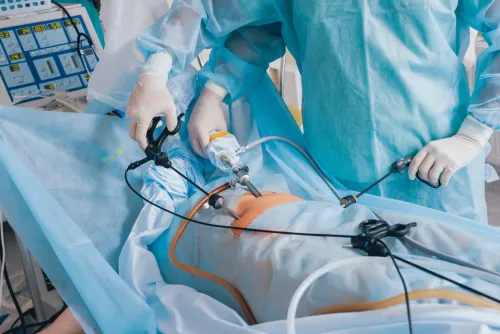
Laparoscopic surgery and robotic surgery use small abdominal incisions for appropriately selected resections. They can reduce abdominal-wall trauma, but a robotic label does not guarantee complete cancer removal or eliminate the need for open surgery.
| Option | Main advantage | When it applies |
|---|---|---|
| Endoscopic resection | Removes selected superficial lesions without abdominal surgery | No deep invasion or significant node risk |
| Laparoscopic surgery | Smaller incisions and less abdominal-wall trauma | Resectable anatomy accessible through instruments |
| Robotic surgery | Flexible instruments and three-dimensional surgical vision | Complex, suitable resections where this access improves control |
| Open surgery | Direct access for extensive disease and reconstruction | Large tumours, major vessel involvement, dense adhesions or difficult lymph-node stations |
The team may convert minimally invasive surgery to open surgery for bleeding, unsafe anatomy, locally advanced invasion or inability to obtain a safe margin. Conversion protects you; it is not automatically a failure.
Planning also addresses anaemia, diabetes, smoking, heart and lung reserve, frailty, sarcopenia, anticoagulants and baseline swallowing, bowel, urinary, sexual and nutritional function. A dietitian may prescribe supplements, correct deficiencies, recommend exercise-based prehabilitation or arrange enteral feeding.
Before colorectal surgery, discuss temporary or permanent stoma risk and request marking by a trained stoma clinician. At Sai Vedant Multi-Speciality Hospital, ask how the surgical team integrates these risks into route selection and recovery planning.
Related services
Cancer Surgeries Cancer Surgery at Sai Vedant Multispeciality Hospital, Pune Sai Vedant Multispeciality Hospital provides advanced cancer surgery services for the... View service → |
Complex GI & General Surgeries Complex GI & General Surgeries Complex GI & General Surgery at Sai Vedant Multispeciality Hospital, Pune Sai Vedant Multispeciality Hospital provides advanced gastrointestinal (GI)... View service → |
Who agrees the plan, and what changes after the operation?
The plan is agreed by a multidisciplinary tumour board, not by the surgeon alone. A gastrointestinal surgeon, medical oncologist, radiation oncologist, radiologist, pathologist, gastroenterologist, anaesthetist and dietitian review the scans, biopsy, vessel involvement, mesorectal fascia, adjacent organs, fitness and your priorities. Their aim is an R0 resection when cure is realistic.
1. Before treatment, ask the team to explain the goal, alternatives and consequences. These include anastomotic leak, infection, ileus, bleeding, cardiopulmonary complications, a temporary or permanent stoma, and a feeding tube. Severe weight loss or sarcopenia may lead to supplements, deficiency correction, exercise-based prehabilitation or enteral feeding.
2. The operation may follow an Enhanced Recovery After Surgery pathway. Shorter fasting, selective bowel preparation, avoiding unnecessary tubes, multimodal pain relief, early movement and early oral feeding support recovery; they do not remove surgical risks.
3. After removal, the final pathology report can change the next step. It records tumour depth, lymph-node involvement, margin status, treatment response, lymphovascular invasion, perineural invasion and relevant biomarkers. Positive nodes, an involved margin or poor treatment response can prompt chemotherapy or radiation; inherited-risk features can prompt genetic evaluation, while lower-risk findings may support surveillance.
4. Ask how the team will review pathology and coordinate nutrition, wound care, bowel or swallowing changes, stoma management and follow-up. A hospital’s coordination process matters as much as its equipment because recovery decisions continue after discharge.
Frequently asked questions
How do doctors turn a digestive cancer diagnosis into a surgical plan?
They combine biopsy and histopathology with imaging to identify the cancer type, stage, location and spread. The team then assesses whether an R0 resection is possible without unacceptable loss of organ function.
When is surgery performed first for digestive cancer?
Surgery is performed first when the tumour appears removable and the patient can tolerate the operation. Chemotherapy, radiotherapy or combined treatment may come before surgery when shrinking or controlling the cancer improves the chance of complete removal.
How is the operation chosen for digestive cancer?
The cancer’s location, size, depth, spread and required margins determine the operation. The plan may include removing the tumour, nearby lymph nodes and involved tissue or organs needed to achieve clear margins.
How do surgeons choose between open, laparoscopic, robotic and endoscopic treatment?
They weigh tumour stage and location, the required margins, access to nearby structures, previous operations and the patient’s fitness. Endoscopic treatment suits selected superficial lesions, while deeper or more extensive cancers require surgical resection.
Who agrees the treatment plan, and what changes after surgery?
A multidisciplinary team reviews the diagnosis, scans, surgical risks and other treatments. After surgery, the final pathology report confirms margins, lymph nodes and tumour features, which can change the need for chemotherapy, radiotherapy or surveillance.
Related services
Robotic Surgeries Robotic Surgery at Sai Vedant Multispeciality Hospital, Pune Sai Vedant Multispeciality Hospital offers advanced robotic surgery solutions designed... View service → |
Breast Surgeries Breast Surgery at Sai Vedant Multispeciality Hospital, Pune Sai Vedant Multispeciality Hospital offers comprehensive breast surgery services for both... View service → |