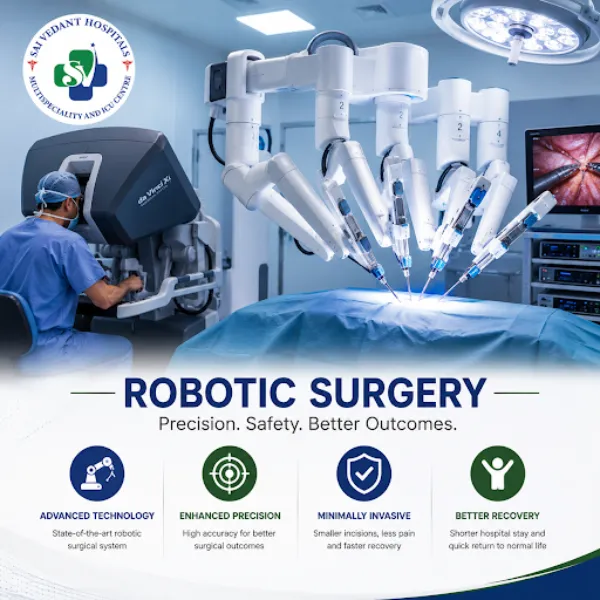
Advances in minimally invasive surgery have expanded the techniques available for selected cancer operations. Robotic Cancer Surgery is one such approach, using a surgeon-controlled robotic platform to perform procedures through small incisions in suitable cases.
It is important to understand that the robot does not operate independently. The surgeon remains in control of the procedure and uses the system to manipulate specialised instruments.
Sai Vedant Multi-Speciality Hospital provides robotic-assisted surgery in Pune for selected cancer and gastrointestinal surgical procedures.
What Makes Robotic Surgery Different
Robotic systems can provide magnified three-dimensional visualisation and instruments capable of precise movement within confined anatomical spaces.
These features may be useful during certain complex procedures.
Potential advantages in appropriately selected patients can include smaller incisions, reduced blood loss, and a minimally invasive recovery pathway. Individual outcomes, however, depend on the procedure, disease complexity, patient health, and other clinical factors.
Which Cancer Operations May Use Robotic Assistance
Robotic techniques can be considered in selected gastrointestinal, colorectal, thoracic, urological, gynaecological, and other cancer procedures.
Suitability cannot be determined simply by the cancer name.
The surgeon considers:
- Tumour location
- Tumour size
- Cancer stage
- Involvement of nearby structures
- Previous operations
- Patient anatomy
- General fitness
- Surgical objectives
Some patients are better treated through conventional laparoscopy or open surgery.
Cancer Control Remains the Priority
The choice of surgical technology should never distract from the fundamental objectives of cancer surgery.
The operation must aim to address the tumour appropriately while following oncological principles, which can include achieving adequate margins and removing relevant lymph nodes when indicated.
A minimally invasive approach is useful only when it supports these clinical goals.
Questions to Ask Before Choosing Robotic Surgery
Patients considering robotic cancer surgery should ask:
- Why is robotic assistance being recommended?
- Is conventional laparoscopic surgery also possible?
- Could open surgery be more appropriate?
- What operation will actually be performed?
- Will lymph nodes need removal?
- What are the major procedure-specific risks?
- What happens if conversion to open surgery becomes necessary?
- What recovery period should I expect?
Answers should relate directly to the patient's cancer and planned procedure.
Planning Treatment in Pune
Robotic surgery is only one component of cancer management. Chemotherapy, pathology, imaging, postoperative care, and follow-up may still be necessary.
Patients should therefore assess the complete cancer treatment pathway rather than choosing care solely because robotic technology is available.
For people in Pune who have been advised to undergo cancer surgery, Sai Vedant Multi-Speciality Hospital can evaluate whether a robotic-assisted approach is appropriate based on tumour characteristics, stage, surgical requirements, and individual health considerations.
Keywords