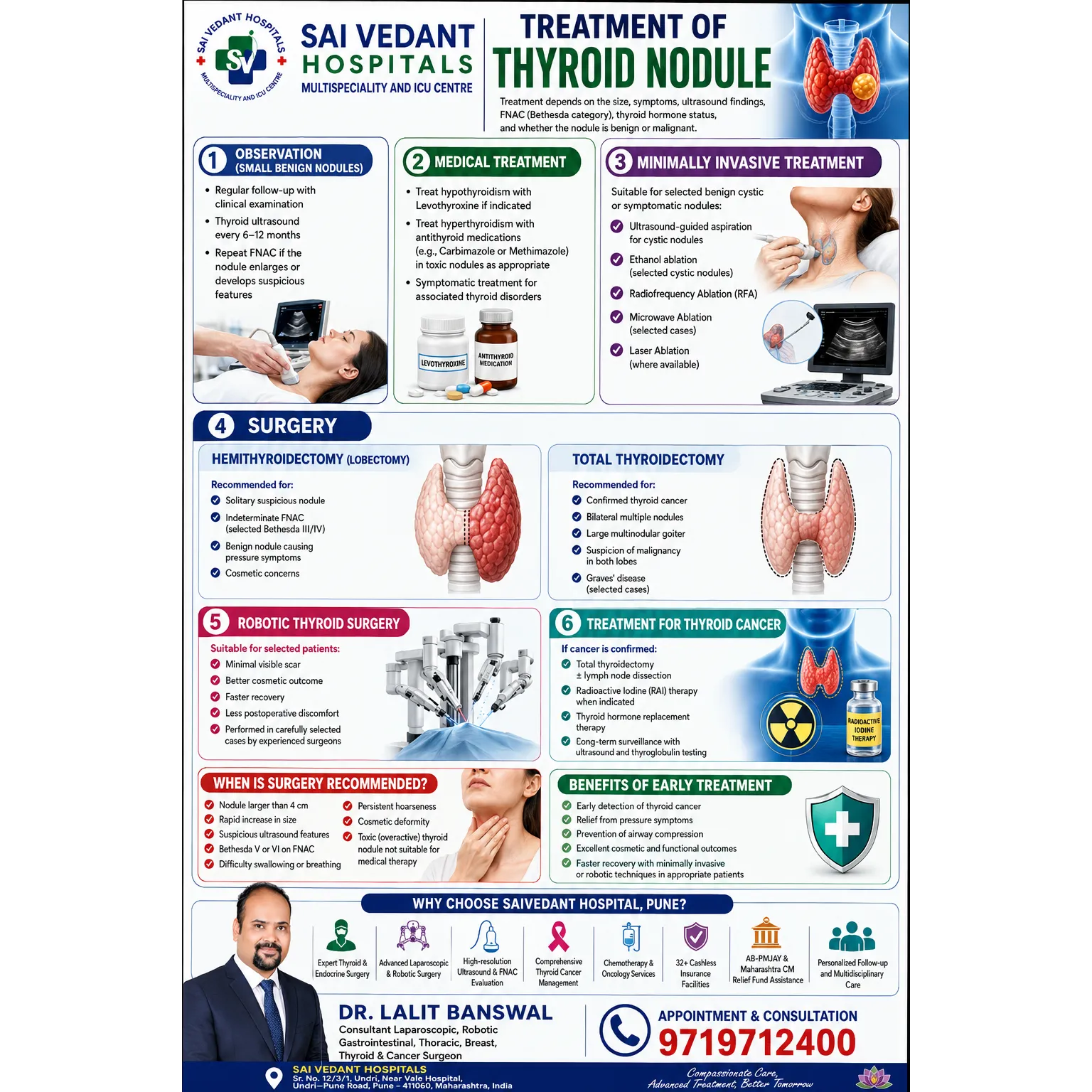
# Treatment of Thyroid Nodule
Treatment depends on the **size, symptoms, ultrasound findings, FNAC (Bethesda category), thyroid hormone status, and whether the nodule is benign or malignant.**
## 1. Observation (Small Benign Nodules)
* Regular follow-up with clinical examination
* Thyroid ultrasound every 6–12 months
* Repeat FNAC if the nodule enlarges or develops suspicious features
## 2. Medical Treatment
* Treat hypothyroidism with **Levothyroxine** if indicated
* Treat hyperthyroidism with **antithyroid medications** (e.g., Carbimazole or Methimazole) in toxic nodules as appropriate
* Symptomatic treatment for associated thyroid disorders
## 3. Minimally Invasive Treatment
Suitable for selected benign cystic or symptomatic nodules:
* Ultrasound-guided aspiration for cystic nodules
* Ethanol ablation (selected cystic nodules)
* Radiofrequency Ablation (RFA)
* Microwave Ablation (selected cases)
* Laser Ablation (where available)
## 4. Surgery
### Hemithyroidectomy (Lobectomy)
Recommended for:
* Solitary suspicious nodule
* Indeterminate FNAC (selected Bethesda III/IV)
* Benign nodule causing pressure symptoms
* Cosmetic concerns
### Total Thyroidectomy
Recommended for:
* Confirmed thyroid cancer
* Bilateral multiple nodules
* Large multinodular goiter
* Suspicion of malignancy in both lobes
* Graves' disease (selected cases)
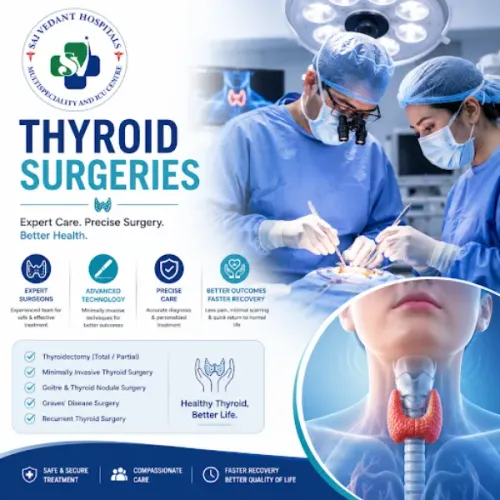
## 5. Robotic Thyroid Surgery
Suitable for selected patients:
* Minimal visible scar
* Better cosmetic outcome
* Faster recovery
* Less postoperative discomfort
* Performed in carefully selected cases by experienced surgeons
## 6. Treatment for Thyroid Cancer
If cancer is confirmed:
* Total thyroidectomy ± lymph node dissection
* Radioactive Iodine (RAI) therapy when indicated
* Thyroid hormone replacement therapy
* Long-term surveillance with ultrasound and thyroglobulin testing
## When is Surgery Recommended?
* Nodule larger than **4 cm**
* Rapid increase in size
* Suspicious ultrasound features
* Bethesda V or VI on FNAC
* Difficulty swallowing or breathing
* Persistent hoarseness
* Cosmetic deformity
* Toxic (overactive) thyroid nodule not suitable for medical therapy
## Benefits of Early Treatment
* Early detection of thyroid cancer
* Relief from pressure symptoms
* Prevention of airway compression
* Excellent cosmetic and functional outcomes
* Faster recovery with minimally invasive or robotic techniques in appropriate patients
## Why Choose SaiVedant Hospital, Pune?
* Expert Thyroid & Endocrine Surgery
* Advanced Laparoscopic & Robotic Surgery
* High-resolution Ultrasound & FNAC Evaluation
* Comprehensive Thyroid Cancer Management
* Chemotherapy & Oncology Services
* **32+ Cashless Insurance Facilities**
* **AB-PMJAY & Maharashtra CM Relief Fund Assistance**
* Personalized follow-up and multidisciplinary care
**Dr. Lalit Banswal**
**Consultant Laparoscopic, Robotic Gastrointestinal, Thoracic, Breast, Thyroid & Cancer Surgeon**
**SaiVedant Hospital, Undri, Pune**
📞 **Appointment: 9719712400**
Treatment depends on the **size, symptoms, ultrasound findings, FNAC (Bethesda category), thyroid hormone status, and whether the nodule is benign or malignant.**
## 1. Observation (Small Benign Nodules)
* Regular follow-up with clinical examination
* Thyroid ultrasound every 6–12 months
* Repeat FNAC if the nodule enlarges or develops suspicious features
## 2. Medical Treatment
* Treat hypothyroidism with **Levothyroxine** if indicated
* Treat hyperthyroidism with **antithyroid medications** (e.g., Carbimazole or Methimazole) in toxic nodules as appropriate
* Symptomatic treatment for associated thyroid disorders
## 3. Minimally Invasive Treatment
Suitable for selected benign cystic or symptomatic nodules:
* Ultrasound-guided aspiration for cystic nodules
* Ethanol ablation (selected cystic nodules)
* Radiofrequency Ablation (RFA)
* Microwave Ablation (selected cases)
* Laser Ablation (where available)
## 4. Surgery
### Hemithyroidectomy (Lobectomy)
Recommended for:
* Solitary suspicious nodule
* Indeterminate FNAC (selected Bethesda III/IV)
* Benign nodule causing pressure symptoms
* Cosmetic concerns
### Total Thyroidectomy
Recommended for:
* Confirmed thyroid cancer
* Bilateral multiple nodules
* Large multinodular goiter
* Suspicion of malignancy in both lobes
* Graves' disease (selected cases)
## 5. Robotic Thyroid Surgery
Suitable for selected patients:
* Minimal visible scar
* Better cosmetic outcome
* Faster recovery
* Less postoperative discomfort
* Performed in carefully selected cases by experienced surgeons
## 6. Treatment for Thyroid Cancer
If cancer is confirmed:
* Total thyroidectomy ± lymph node dissection
* Radioactive Iodine (RAI) therapy when indicated
* Thyroid hormone replacement therapy
* Long-term surveillance with ultrasound and thyroglobulin testing
## When is Surgery Recommended?
* Nodule larger than **4 cm**
* Rapid increase in size
* Suspicious ultrasound features
* Bethesda V or VI on FNAC
* Difficulty swallowing or breathing
* Persistent hoarseness
* Cosmetic deformity
* Toxic (overactive) thyroid nodule not suitable for medical therapy
## Benefits of Early Treatment
* Early detection of thyroid cancer
* Relief from pressure symptoms
* Prevention of airway compression
* Excellent cosmetic and functional outcomes
* Faster recovery with minimally invasive or robotic techniques in appropriate patients
## Why Choose SaiVedant Hospital, Pune?
* Expert Thyroid & Endocrine Surgery
* Advanced Laparoscopic & Robotic Surgery
* High-resolution Ultrasound & FNAC Evaluation
* Comprehensive Thyroid Cancer Management
* Chemotherapy & Oncology Services
* **32+ Cashless Insurance Facilities**
* **AB-PMJAY & Maharashtra CM Relief Fund Assistance**
* Personalized follow-up and multidisciplinary care
**Dr. Lalit Banswal**
**Consultant Laparoscopic, Robotic Gastrointestinal, Thoracic, Breast, Thyroid & Cancer Surgeon**
**SaiVedant Hospital, Undri, Pune**
📞 **Appointment: 9719712400**
Keywords