# Renal Colic Symptoms and Diagnosis (Kidney Stone Pain)
**Renal Colic Symptoms and Diagnosis | Early Signs of Kidney Stones | Dr. Lalit Banswal | SaiVedant Hospital, Pune**
Learn the symptoms and diagnosis of renal colic (kidney stone pain). Understand warning signs, investigations, and when to seek emergency medical care. Consult Dr. Lalit Banswal at SaiVedant Hospital, Undri, Pune.
---
# Renal Colic: Symptoms and Diagnosis
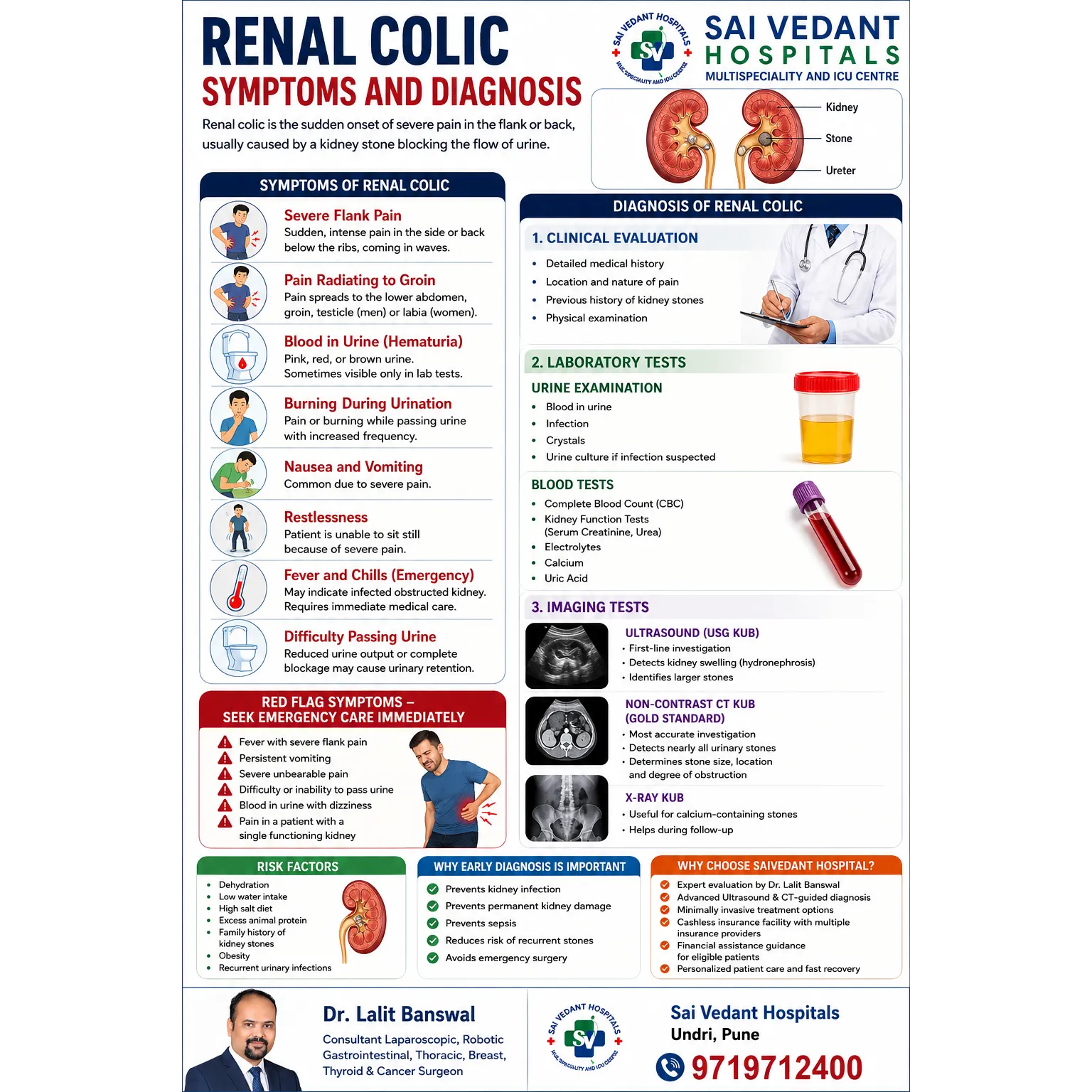
**Renal colic** is one of the most severe forms of pain experienced by patients. It usually occurs when a **kidney stone blocks the flow of urine**, causing increased pressure within the urinary tract and painful spasms of the ureter.
Early diagnosis and prompt treatment can prevent kidney damage, infection, and complications.
---
## What is Renal Colic?
Renal colic refers to the **sudden onset of severe flank pain** caused by obstruction of the urinary tract, most commonly due to a kidney or ureteric stone.
---
# Common Symptoms of Renal Colic
### 🔹 Severe Flank Pain
* Sudden, intense pain in the side or back
* Usually starts below the ribs
* May come in waves (colicky pain)
### 🔹 Pain Radiating to Groin
* Pain travels from the flank to:
* Lower abdomen
* Groin
* Testicle (men)
* Labia (women)
### 🔹 Blood in Urine (Hematuria)
* Pink, red, or brown urine
* Sometimes visible only on urine examination
### 🔹 Burning During Urination
* Pain while passing urine
* Increased urinary frequency
### 🔹 Nausea and Vomiting
* Common due to severe pain
### 🔹 Restlessness
* Patients are unable to sit still because of severe pain
### 🔹 Fever and Chills (Emergency)
* May indicate infected obstructed kidney
* Requires immediate hospitalization
### 🔹 Difficulty Passing Urine
* Reduced urine output
* Complete blockage may cause urinary retention
---
# Diagnosis of Renal Colic
## Clinical Evaluation
✔ Detailed medical history
✔ Location and nature of pain
✔ Previous history of kidney stones
✔ Physical examination
---
## Laboratory Tests
### Urine Examination
* Blood in urine
* Infection
* Crystals
* Urine culture if infection suspected
### Blood Tests
* Complete Blood Count (CBC)
* Kidney Function Tests (Serum Creatinine, Urea)
* Electrolytes
* Calcium
* Uric Acid
---
# Imaging Tests
### Ultrasound (USG KUB)
* First-line investigation
* Detects kidney swelling (hydronephrosis)
* Identifies larger stones
### Non-Contrast CT KUB (Gold Standard)
* Most accurate investigation
* Detects nearly all urinary stones
* Determines:
* Stone size
* Stone location
* Degree of obstruction
### X-ray KUB
* Useful for calcium-containing stones
* Helps during follow-up
---
# Red Flag Symptoms – Seek Emergency Care Immediately
🚨 Fever with severe flank pain
🚨 Persistent vomiting
🚨 Severe unbearable pain
🚨 Difficulty or inability to pass urine
🚨 Blood in urine with dizziness
🚨 Pain in a patient with a single functioning kidney
---
# Risk Factors
* Dehydration
* Low water intake
* High salt diet
* Excess animal protein
* Family history of kidney stones
* Obesity
* Recurrent urinary infections
---
# Why Early Diagnosis is Important
Early diagnosis helps prevent:
* Kidney infection
* Permanent kidney damage
* Sepsis
* Recurrent stone formation
* Need for emergency surgery
---
## Why Choose SaiVedant Hospital, Undri, Pune?
✅ Expert evaluation by **Dr. Lalit Banswal**
**Consultant Laparoscopic, Robotic Gastrointestinal, Thoracic, Breast, Thyroid & Cancer Surgeon**
✅ Advanced Ultrasound & CT-guided diagnosis
✅ Minimally invasive treatment options
✅ Cashless insurance facility with multiple insurance providers
✅ Financial assistance guidance for eligible patients
✅ Personalized patient care and fast recovery
📍 **SaiVedant Hospital, Undri, Pune**
📞 **Appointment: 9719712400**
---
Renal colic symptoms, kidney stone pain, ureteric stone symptoms, blood in urine, flank pain, kidney stone diagnosis, CT KUB, ultrasound KUB, renal colic treatment, kidney stone specialist Pune, Dr Lalit Banswal, SaiVedant Hospital, Undri Pune.
**Renal Colic Symptoms and Diagnosis | Early Signs of Kidney Stones | Dr. Lalit Banswal | SaiVedant Hospital, Pune**
Learn the symptoms and diagnosis of renal colic (kidney stone pain). Understand warning signs, investigations, and when to seek emergency medical care. Consult Dr. Lalit Banswal at SaiVedant Hospital, Undri, Pune.
---
# Renal Colic: Symptoms and Diagnosis
**Renal colic** is one of the most severe forms of pain experienced by patients. It usually occurs when a **kidney stone blocks the flow of urine**, causing increased pressure within the urinary tract and painful spasms of the ureter.
Early diagnosis and prompt treatment can prevent kidney damage, infection, and complications.
---
## What is Renal Colic?
Renal colic refers to the **sudden onset of severe flank pain** caused by obstruction of the urinary tract, most commonly due to a kidney or ureteric stone.
---
# Common Symptoms of Renal Colic
### 🔹 Severe Flank Pain
* Sudden, intense pain in the side or back
* Usually starts below the ribs
* May come in waves (colicky pain)
### 🔹 Pain Radiating to Groin
* Pain travels from the flank to:
* Lower abdomen
* Groin
* Testicle (men)
* Labia (women)
### 🔹 Blood in Urine (Hematuria)
* Pink, red, or brown urine
* Sometimes visible only on urine examination
### 🔹 Burning During Urination
* Pain while passing urine
* Increased urinary frequency
### 🔹 Nausea and Vomiting
* Common due to severe pain
### 🔹 Restlessness
* Patients are unable to sit still because of severe pain
### 🔹 Fever and Chills (Emergency)
* May indicate infected obstructed kidney
* Requires immediate hospitalization
### 🔹 Difficulty Passing Urine
* Reduced urine output
* Complete blockage may cause urinary retention
---
# Diagnosis of Renal Colic
## Clinical Evaluation
✔ Detailed medical history
✔ Location and nature of pain
✔ Previous history of kidney stones
✔ Physical examination
---
## Laboratory Tests
### Urine Examination
* Blood in urine
* Infection
* Crystals
* Urine culture if infection suspected
### Blood Tests
* Complete Blood Count (CBC)
* Kidney Function Tests (Serum Creatinine, Urea)
* Electrolytes
* Calcium
* Uric Acid
---
# Imaging Tests
### Ultrasound (USG KUB)
* First-line investigation
* Detects kidney swelling (hydronephrosis)
* Identifies larger stones
### Non-Contrast CT KUB (Gold Standard)
* Most accurate investigation
* Detects nearly all urinary stones
* Determines:
* Stone size
* Stone location
* Degree of obstruction
### X-ray KUB
* Useful for calcium-containing stones
* Helps during follow-up
---
# Red Flag Symptoms – Seek Emergency Care Immediately
🚨 Fever with severe flank pain
🚨 Persistent vomiting
🚨 Severe unbearable pain
🚨 Difficulty or inability to pass urine
🚨 Blood in urine with dizziness
🚨 Pain in a patient with a single functioning kidney
---
# Risk Factors
* Dehydration
* Low water intake
* High salt diet
* Excess animal protein
* Family history of kidney stones
* Obesity
* Recurrent urinary infections
---
# Why Early Diagnosis is Important
Early diagnosis helps prevent:
* Kidney infection
* Permanent kidney damage
* Sepsis
* Recurrent stone formation
* Need for emergency surgery
---
## Why Choose SaiVedant Hospital, Undri, Pune?
✅ Expert evaluation by **Dr. Lalit Banswal**
**Consultant Laparoscopic, Robotic Gastrointestinal, Thoracic, Breast, Thyroid & Cancer Surgeon**
✅ Advanced Ultrasound & CT-guided diagnosis
✅ Minimally invasive treatment options
✅ Cashless insurance facility with multiple insurance providers
✅ Financial assistance guidance for eligible patients
✅ Personalized patient care and fast recovery
📍 **SaiVedant Hospital, Undri, Pune**
📞 **Appointment: 9719712400**
---
Renal colic symptoms, kidney stone pain, ureteric stone symptoms, blood in urine, flank pain, kidney stone diagnosis, CT KUB, ultrasound KUB, renal colic treatment, kidney stone specialist Pune, Dr Lalit Banswal, SaiVedant Hospital, Undri Pune.
Keywords