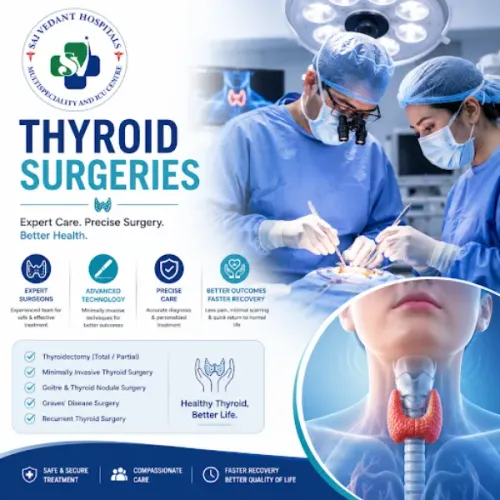
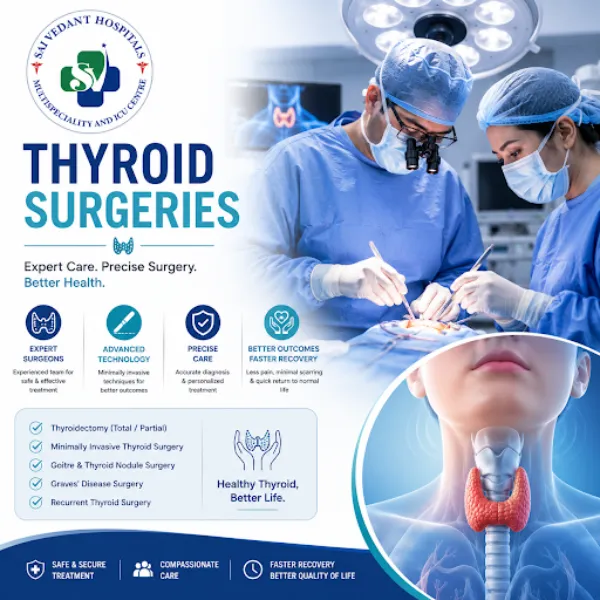
Many thyroid conditions can be managed without an operation, which is why being advised to consider Thyroid Surgery can raise understandable questions. Surgery may become appropriate when thyroid enlargement, nodules, suspicious findings, functional problems, or confirmed cancer require operative management.
Patients in Pune and across Maharashtra commonly undergo thyroid evaluation using clinical examination, blood investigations, ultrasound, and, when indicated, needle-based diagnostic testing.
Sai Vedant Multi-Speciality Hospital provides thyroid surgical services as part of its general and specialised surgical care in Pune.
Conditions That Can Lead to Surgery
Not every thyroid nodule needs removal. A surgeon considers several factors before recommending an operation.
Possible reasons include:
- Confirmed thyroid cancer
- Nodules suspicious for malignancy
- Large thyroid nodules
- Multinodular goitre
- Enlarged thyroid causing pressure symptoms
- Selected cases of hyperthyroidism
- Recurrent thyroid problems
- Certain thyroid cysts
Difficulty swallowing, neck pressure, visible enlargement, voice changes, and breathing discomfort can also require further assessment, although these symptoms can have several causes.
Different Types of Thyroid Operations
The amount of thyroid tissue removed depends on the underlying condition.
A hemithyroidectomy typically removes one thyroid lobe. It may be considered when disease is limited to one side and complete removal is not necessary.
A total thyroidectomy removes the thyroid gland and may be recommended for selected cancers, large multinodular goitres, or other conditions where complete removal is clinically indicated.
The exact procedure should be determined after reviewing diagnostic findings and discussing expected benefits and risks.
What Happens Before Surgery
Preoperative assessment may include thyroid function tests, ultrasound findings, cytology reports, blood investigations, anaesthetic evaluation, and other tests based on the patient's condition.
Patients should tell their medical team about medications, previous operations, allergies, and existing health conditions.
It is also useful to discuss whether thyroid hormone replacement is likely to be needed after the procedure.
Understanding Important Surgical Considerations
The thyroid lies close to structures involved in voice and calcium regulation. Surgical planning therefore requires careful attention to the recurrent laryngeal nerves and parathyroid glands.
Potential complications vary according to the type and complexity of surgery. Patients should receive individual counselling about bleeding, infection, voice changes, calcium-related problems, and other procedure-specific risks.
Life After Thyroid Surgery
Recovery depends on the extent of surgery and the patient's overall health. Some people return gradually to normal activities within a relatively short period, while others require additional monitoring.
Patients undergoing total thyroid removal generally require thyroid hormone replacement. Follow-up may include thyroid function tests and medication adjustments.
When thyroid cancer is involved, additional oncology or endocrine follow-up may also form part of the treatment plan.
For people in Pune considering thyroid surgery, the key first step is establishing why surgery has been recommended. A consultation at Sai Vedant Multi-Speciality Hospital can help patients understand the diagnosis, proposed procedure, preparation, and expected follow-up before making treatment decisions.
Keywords