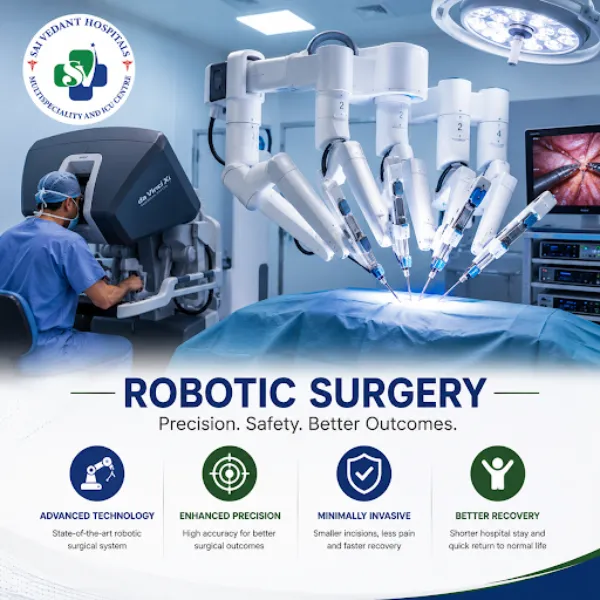
Advances in surgical technology have changed how certain cancer operations can be performed. One such development is Robotic Cancer Surgery, a minimally invasive approach in which a trained surgeon controls specialized robotic instruments to perform selected procedures through small incisions.
The word robotic can sometimes create the impression that a machine performs the operation independently. That is not how the technology works. The surgeon remains in control throughout the procedure, using a console and highly articulated instruments to carry out carefully planned surgical movements.
How Robotic Surgery Works
During a robotic procedure, small instruments and a camera are introduced through planned incisions. The system provides the operating surgeon with a magnified view of the surgical field and instruments capable of controlled movements within confined anatomical areas.
Depending on the cancer type and individual case, this approach may help surgeons work around delicate structures while limiting the size of external incisions.
Potential clinical advantages in appropriately selected cases can include:
- Smaller surgical incisions
- Enhanced visualization
- Precise instrument movement
- Reduced disruption of surrounding tissue
- Potentially shorter recovery in some procedures
- Improved access within certain confined anatomical spaces
These benefits are not identical for every patient or operation.
Which Patients May Be Considered
Robotic techniques can be used in selected procedures involving different organ systems. Suitability depends on tumour characteristics, disease extent, anatomy, previous operations, overall health, and the surgeon's assessment.
A patient should therefore not assume that robotic surgery is automatically preferable simply because the technology is available.
In some situations, conventional open surgery may provide the most appropriate access. In others, laparoscopic or robotic techniques may be considered.
Technology Does Not Replace Surgical Planning
Successful cancer surgery depends on much more than the surgical platform. Accurate diagnosis, staging, imaging review, surgical experience, anaesthesia, pathology, postoperative monitoring, and coordinated cancer treatment remain essential.
Patients considering Robotic Cancer Surgery in Pune should ask how the proposed technique fits their specific diagnosis rather than focusing only on the technology.
Sai Vedant Multi-Speciality Hospital provides surgical evaluation within a broader multispeciality care environment, where the suitability of an operative approach can be assessed according to individual clinical findings.
What Patients Should Discuss Beforehand
Before proceeding, patients can ask their surgical team about:
- Why a robotic approach is being considered
- Whether other surgical approaches are suitable
- The expected extent of tumour removal
- Possibility of conversion to open surgery if required
- Anaesthesia and preparation requirements
- Expected hospitalization
- Recovery milestones
- Follow-up treatment after pathology results
These discussions are particularly important in cancer care because the operation is often one component of a longer treatment plan.
Making Technology Relevant to the Patient
The value of robotic surgery lies in using the technology for an appropriate clinical indication. It should not be treated as a universal solution or as evidence that one procedure will necessarily produce a better outcome.
For patients and families across Pune and Maharashtra, informed decision-making begins with understanding the cancer itself. When robotic techniques are clinically suitable, they may provide a minimally invasive surgical option supported by careful planning, appropriate expertise, and structured postoperative care.
Keywords